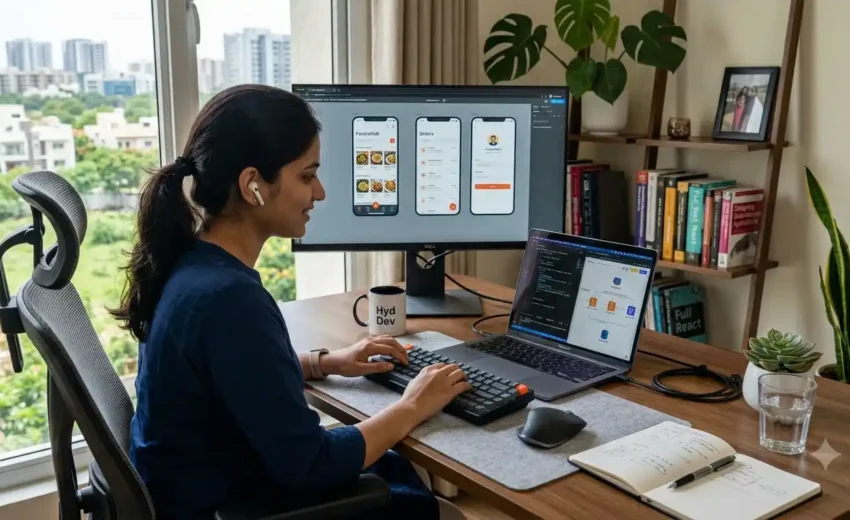
Freelance Full-Stack Mobile App Developer in Hyderabad When You Actually Need One
Most mobile apps aren’t just a mobile app. Behind the screens users tap through, there’s a backend storing data, an API connecting the two, and often an admin panel someone on your team uses to manage content or orders. Treating “build my app” as a single, isolated task is how a lot of projects end up with a beautiful frontend connected to a backend that can’t actually support real usage.
A freelance full-stack mobile app developer in Hyderabad handles the app and everything behind it as one connected system, rather than as separate pieces built in isolation. I’ve worked this way across mobile app projects that needed real backend infrastructure — booking platforms, marketplace apps, quick-commerce products — and this guide covers when that approach actually matters, and how the architecture comes together.
What Full Stack Actually Means for a Mobile App
Full-stack mobile development covers three connected layers, and a freelance full-stack mobile app developer in Hyderabad should be comfortable across all of them:
The mobile app itself — the interface users interact with, built using Flutter, React Native, or native iOS and Android frameworks depending on the project’s requirements.
The backend and API layer — the server-side system that stores data, handles business logic, manages user authentication, and exposes the endpoints the app communicates with.
Supporting infrastructure — often an admin dashboard, sometimes built as a companion web application, that lets your team manage content, orders, or users without touching the mobile app itself.
When You Genuinely Need a Full-Stack Mobile App Developer
Not every app requires this. A simple app with static content and no real backend logic doesn’t need full-stack expertise. But a few project types make it worth prioritizing:
Apps with custom business logic. If your app calculates pricing, manages inventory, or handles multi-step workflows, the backend needs to be designed alongside the app from the start, not bolted on afterward.
Apps requiring an admin panel. Marketplace, booking, and content-driven apps almost always need a way for your team to manage what users see, which means backend and admin tooling built in sync with the mobile experience.
Apps with real-time features. Live order tracking, chat, or notifications require backend architecture that’s tightly coordinated with how the app consumes and displays that data.
Apps expected to scale. If you’re planning for real user growth, backend decisions made early — database structure, API design, caching strategy — directly affect how well the app performs later.
How the Architecture Actually Comes Together
API Design as the Connective Layer
The API is what lets your mobile app and backend communicate. A freelance full-stack mobile app developer in Hyderabad designs this layer with both sides in mind — structuring endpoints so the app gets exactly the data it needs, efficiently, without unnecessary back-and-forth requests that slow the experience down.
Database Structure Built for Real Usage
Database schema decisions made early determine how easily your app can grow later. A well-structured database supports the features you have today while leaving room for the features you’ll likely add once the app is live and generating real usage patterns.
Authentication and Data Security
User login, session management, and data protection need to be handled consistently between the app and backend. This is one of the areas where having one developer own both layers reduces the risk of gaps that a split team, handing work back and forth, might miss.
Admin Tools That Actually Match the App
An admin panel built without understanding the mobile app’s actual data structure often ends up clunky or missing key functionality. When the same full stack development approach covers both, the admin experience reflects what the app actually needs to manage.
Key Benefits of Hiring One Full-Stack Developer Over Separate Specialists
Fewer integration issues, since the person building the API also understands exactly how the app will consume it
Faster decision-making, without needing to coordinate changes across a frontend developer, backend developer, and possibly a third person for the admin panel
Lower total cost in most cases, compared to hiring three separate specialists for a project of moderate complexity
Consistent architecture decisions, since one person maintains a complete mental model of the system instead of three partial views
Simpler ongoing maintenance, with a single point of contact who understands the entire technical picture
Common Mistakes When Hiring for Full-Stack Mobile Projects
Hiring a mobile specialist for a project that’s really a backend problem. If your core challenge is data structure or business logic, prioritize backend depth, not just app polish.
Underestimating the API design phase. This layer often gets rushed, and problems here surface later as slow app performance or awkward data handling.
Not planning the admin panel from day one. Adding it as an afterthought usually means retrofitting the backend to support functionality it wasn’t originally designed for.
Assuming full-stack means equally strong everywhere. Ask specifically about backend and database experience, not just the mobile portion of past projects — some developers lean heavier toward one side.
Expert Tips for a Smooth Full-Stack Mobile Engagement
Ask to see a past project where the same developer handled both the app and backend, not just the frontend
Discuss expected user growth early, so database and API decisions account for it from the start
Request a clear diagram or explanation of how data flows between the app, API, and any admin tools
Confirm who owns backend hosting and infrastructure decisions after launch
Budget time specifically for API design and testing — it’s easy to underestimate this phase when focused on app screens
Frequently Asked Questions
1. Do I need a full-stack developer, or just an app developer?
If your app has real backend logic, needs an admin panel, or is expected to scale, full-stack expertise matters. Simple, mostly static apps may not require it.
2. Is hiring one full-stack developer cheaper than hiring separate specialists?
Usually yes, for projects of moderate complexity, since you avoid the overhead of coordinating multiple people and reduce integration issues between layers.
3. What backend technologies should a full-stack mobile developer know?
This depends on your project, but common choices include Node.js, Python-based frameworks, or Firebase, paired with a relational or NoSQL database depending on data structure needs.
4. Can a full-stack mobile app developer also build the admin panel?
Yes, and it’s often an advantage — the admin panel typically works better when built by someone who understands the app’s data model firsthand.
5. How does full-stack development affect app performance?
Well-designed API and database architecture directly improves app speed and reliability, especially as user numbers grow.
6. Can you rebuild or upg6. Should I plan for scale even if I'm launching a small MVP?rade an existing android app?
You don’t need to over-engineer for scale you don’t have yet, but basic architecture decisions should avoid painting you into a corner if the app does grow.
7. What's the biggest risk of splitting frontend and backend across different freelancers?
Miscommunication at the API layer is the most common issue — mismatched expectations about data formats or response structure that only surface during integration testing.
Conclusion
A freelance full-stack mobile app developer in Hyderabad makes the most sense when your app depends on real backend logic, an admin panel, or future scale — situations where treating the app and its infrastructure as one connected system prevents the integration issues that split teams often run into. For simpler, mostly static apps, that level of expertise may be more than you need.
Strong Call to Action
Not sure whether your project needs full-stack expertise or a more focused app build? Get in touch for a free consultation and get honest guidance before you commit.